




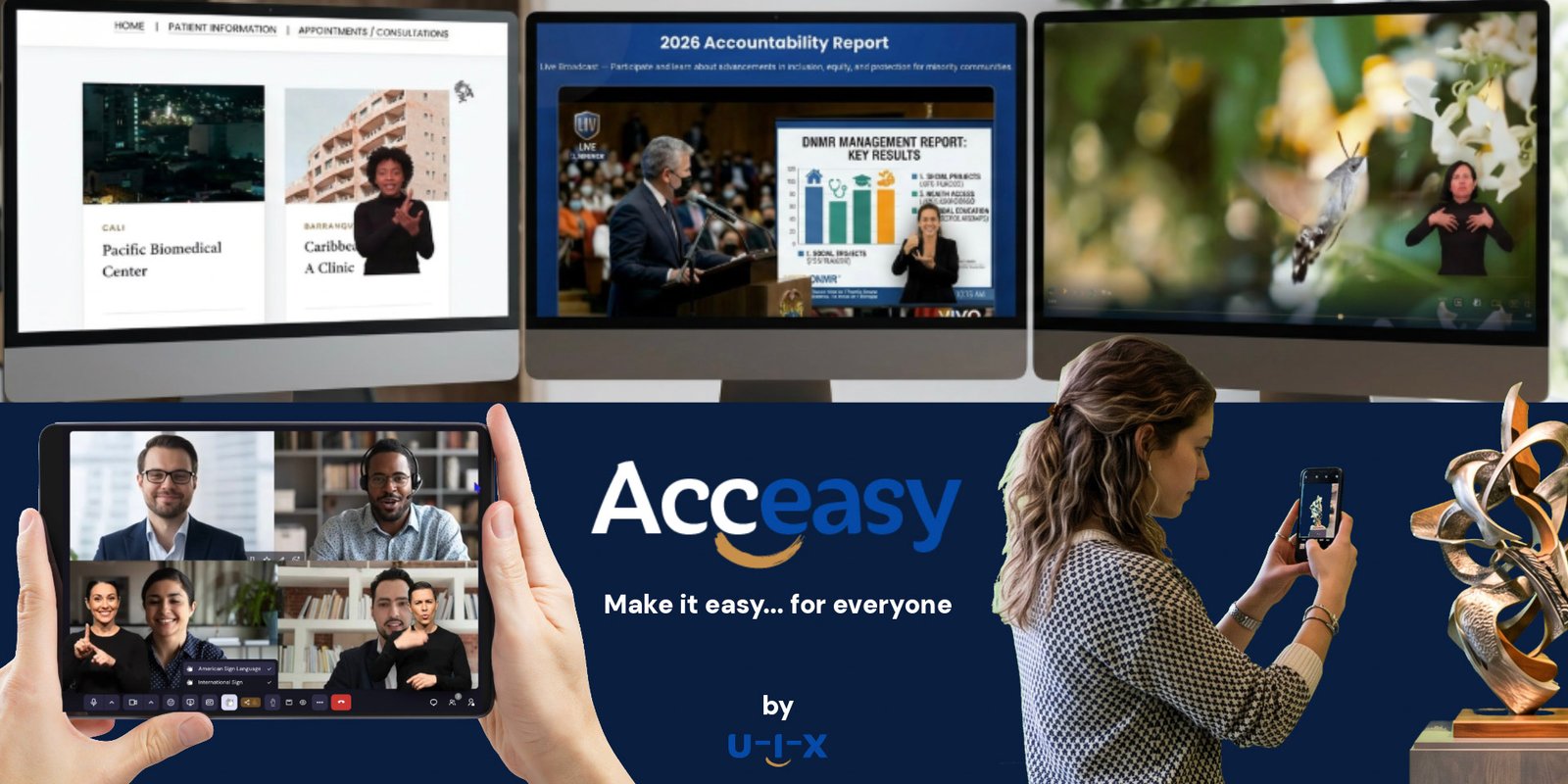

Deaf Digital Inclusion & Standards

Sign Language Accessibility for the Modern Digital World

Empowering Deaf and hard-of-hearing communities with synchronized, interactive sign language overlays across websites, video calls, live broadcasts, media players, and physical venues.

Why Captions Aren't Enough
Acceasy Multimodal Sign Language Platform
Understanding Deaf Accessibility

Why Closed Captions Alone Are Not Full Accessibility

Over 70 million Deaf individuals worldwide communicate primarily through sign language. Here is why true accessibility requires native visual translation.

Sign Language is a Primary Native Language, Not a Translation of Text

A widespread misconception in web accessibility is that providing text captions (closed captions) fully solves digital inclusion for Deaf users. In reality, for many individuals who are pre-lingually Deaf, sign language (such as ASL, LSC, LIBRAS, or BSL) is their first and natural language (L1). Written text in English, Spanish, or Portuguese is their second language (L2).

Natural sign languages possess rich 3D spatial grammars, distinct syntax, facial expressions (non-manual markers), and cultural nuance that linear 2D text transcripts cannot express. Providing information exclusively in text forces Deaf users to navigate complex second-language comprehension hurdles.

Traditional Approach (Captions Only)

  • Linear text that omits emotional inflection and tone
  • Assumes advanced reading literacy in a second language
  • Fails WCAG 2.1/2.2 Level AAA Success Criterion 1.2.6
  • Requires reading fast-scrolling text while trying to watch video content

Acceasy Multimodal Overlays (Sign Language)

  • Qualified native human interpreters delivering spatial nuance
  • First-language access in ASL, LSC, LIBRAS, and International Sign
  • Supports WCAG Level AAA conformance goals
  • Non-intrusive, floating toggleable layer with zero code refactoring
The Acceasy Ecosystem

Comprehensive Sign Language Solutions for Every Touchpoint

Acceasy transforms every digital channel into an inclusive, barrier-free experience.

Frequently Asked Questions

Sign Language Accessibility & Deaf Inclusivity

Answers to common questions regarding sign language technology, legal compliance, and implementation.

Why are text captions not enough for Deaf accessibility?

For many pre-lingually Deaf individuals, sign language (such as ASL, LSC, or LIBRAS) is their primary native language, while written text represents a second language with an entirely different syntax. Sign language overlays convey tone, spatial relationships, emotion, and nuances that captions cannot capture.

How does Acceasy integrate with existing web architectures?

Acceasy Web injects a lightweight, non-intrusive overlay layer via a single JavaScript snippet. When activated by the user, high-definition human sign language translation appears synchronized with the webpage content without altering backend code or underlying layout design.

What sign languages are supported?

Acceasy natively supports American Sign Language (ASL), Lengua de Señas Colombiana (LSC), Língua Brasileira de Sinais (LIBRAS), and International Sign (IS), with architectural capacity to onboard additional regional sign languages.

Does sign language help with WCAG AAA compliance?

Yes. WCAG 2.1 & 2.2 Success Criterion 1.2.6 (Sign Language - Prerecorded, Level AAA) specifically mandates sign language interpretation for all prerecorded audio content in synchronized media.

Can the sign language overlay be customized by the user?

Yes. Users can resize the interpreter window, adjust playback speed, change position on the screen, and switch between regional sign languages or hide the overlay at any time.