





Section 508 Standards & ICT Accessibility Support
Federal agencies, government contractors (FAR 39.2), and federally funded institutions must ensure Information and Communication Technology (ICT) is accessible without hearing. Acceasy provides synchronized American Sign Language (ASL) translation overlays, video meetings with an overlay for your own interpreters, multimodal video players, and plain language adaptations to support federal accessibility goals with zero code refactoring.
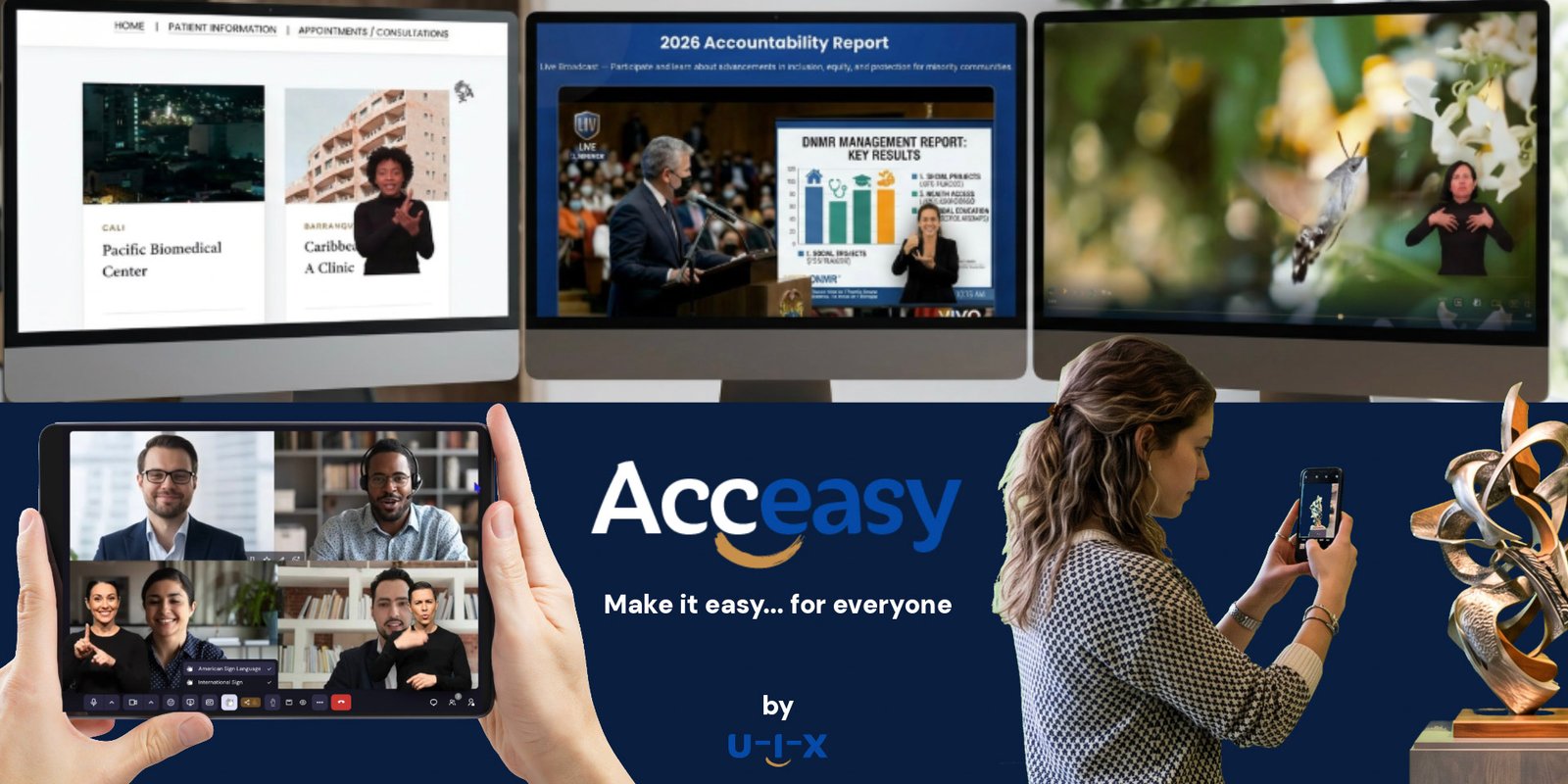
The Federal ICT Accessibility Requirement
Under Section 508 of the Rehabilitation Act of 1973 (29 U.S.C. § 794d) and the Revised Section 508 Standards (36 CFR Part 1194) administered by the U.S. Access Board and GSA (Section508.gov), federal agencies are required to provide accessible electronic content, software, and two-way voice communications. For deaf and hard-of-hearing citizens and federal employees, text captions alone often fall short of full primary language communication. Acceasy delivers authentic American Sign Language (ASL) translation layers in partnership with Visual Voice Media to support genuine functional performance conformance.
Section 508 Criteria Addressed by Acceasy
Direct technical alignment with Revised 508 Chapters 3 (Functional Performance), 5 (Software), and WCAG Standards.
| Section 508 Chapter / Rule | Standard / Provision | Federal Requirement | Acceasy Alignment Solution | Acceasy Support |
|---|---|---|---|---|
| Chapter 3 · 302.3 | FPC Without Hearing | Where ICT provides auditory modes of operation, provide at least one visual mode of operation that does not require user hearing. | Acceasy Web & Acceasy Player: Synchronized, human-translated ASL overlays and visual leaf-node bindings. | |
| Chapter 3 · 302.2 | FPC With Limited Hearing | Where ICT provides auditory modes of operation, provide at least one mode that improves audio clarity and visual speech recognition. | Acceasy Meet & Acceasy Live: Synchronized live captions, adjustable contrast, and floating interpreter streams. | |
| Chapter 5 · 504.2 | Software Two-Way Voice & Video | Real-time video communications must support video remote interpreting (VRI), visual clarity, and real-time captioning synchronization. | Acceasy Meet: Floating, background-free ASL interpreter window with dedicated user scaling and zero host dependencies. | |
| Chapter 5 · 503 & WCAG 1.2.6 | Multimedia Sign Language (Prerecorded) | Prerecorded video and training media in federal applications must provide synchronized sign language interpreting. | Acceasy Player (AVP): Picture-in-Picture (PiP) and transparent ASL track synchronization for federal video catalogs. | |
| Chapter 3 · 302.7 | Cognitive Plain Language | Provide visual modes and simplified language to accommodate cognitive, language, and learning abilities (Plain Writing Act of 2010 / ISO 24495-1). | Plain Language Consulting: Plain writing audits, ISO 24495-1 adaptations, and multimodal visual guides. | |
| Chapter 4 · 402/407 | Physical ICT Kiosks & Exhibits | Public terminals, museum displays, and physical agency information stations must provide operable visual/sign language alternatives. | Acceasy Dive: Web-based camera recognition playing ASL descriptions on user devices with zero app downloads. |
Five Solutions for Federal Conformance
Purpose-built tools delivering seamless sign language accessibility across all federal touchpoints.

Acceasy Web
Client-side overlay integrating synchronized American Sign Language (ASL) on public agency portals and forms. Zero backend modifications.
Explore Acceasy Web →
Acceasy Meet
Accessible video conferencing for federal hearings, town halls, and internal agency operations with dedicated floating ASL interpreter windows.
Explore Acceasy Meet →
Acceasy Live
Ultra-low latency transparent ASL interpreter overlay for federal live streams, press briefings, and emergency public announcements.
Explore Acceasy Live →
Acceasy Player (AVP)
Multimodal video player with Picture-in-Picture ASL tracks, keyboard navigation, and alignment with Section 508 media guidelines.
Explore Acceasy Player →
Acceasy Dive
Spatial camera recognition for national parks, museums, exhibitions, medical centers, and federal visitor kiosks without app downloads.
Explore Acceasy Dive →Section 508 Standards & Conformance Support
Does Section 508 require sign language interpreting?
Under Section 508 Chapter 3 Criterion 302.3 (Functional Performance Criteria: Without Hearing), ICT that relies on auditory modes must provide at least one visual mode of operation that does not require user hearing. Furthermore, Section 508 incorporates WCAG standards requiring synchronized sign language (1.2.6) for prerecorded multimedia.
How does Acceasy ensure security and privacy for federal infrastructure?
Acceasy operates as a lightweight, sandboxed client-side layer. It does not harvest, store, or transmit citizen PII (Personally Identifiable Information) and requires no server-side backend integration.
Why are synthetic AI avatars insufficient for Section 508 federal conformance?
Automated AI avatars lack the grammatical accuracy, facial morphology, and spatial syntax required for American Sign Language. The World Federation of the Deaf (WFD) and National Association of the Deaf (NAD) have explicitly cautioned against AI avatars in public communications. Acceasy utilizes qualified professional human ASL translators and interpreters in partnership with Visual Voice Media.
What is the difference between Section 508 and ADA Title III?
Section 508 specifically mandates accessibility for U.S. Federal departments, agencies, and federal procurement (FAR 39.2), whereas ADA Title III applies to private businesses and places of public accommodation. Acceasy solutions are designed to support conformance across both legal frameworks.