




European Accessibility Act & EN 301 549: Sign Language Accessibility for the EU
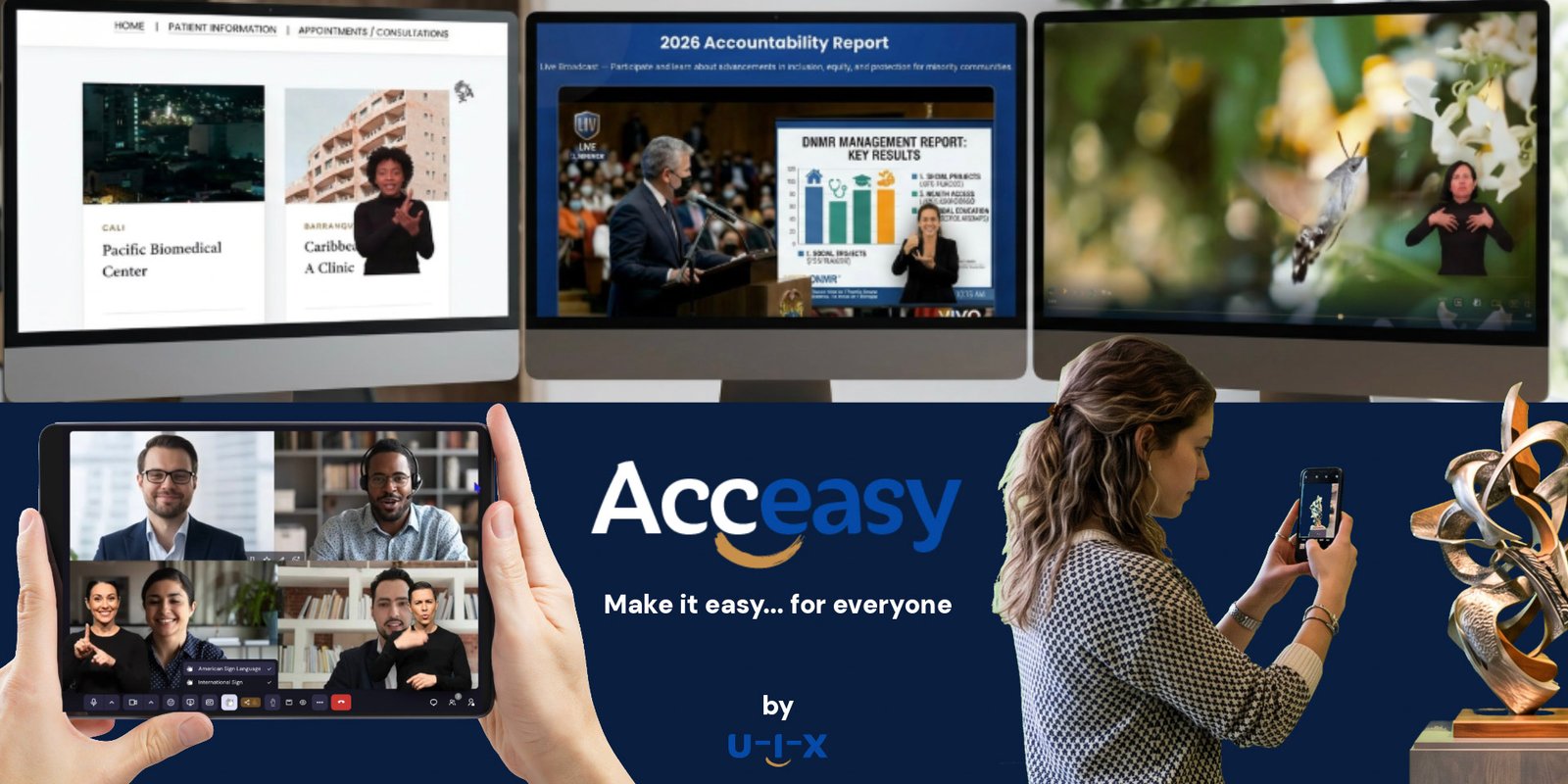
Since 28 June 2025 the European Accessibility Act applies to e-commerce, banking, transport, telecoms, e-books and audiovisual services across the EU, while the Web Accessibility Directive already covers every public-sector website and app. Both point to the same harmonised standard, EN 301 549. Acceasy adds what checklists and automated widgets cannot: real human sign language, in any sign language, on top of what you already run — websites, video players, live streams, video meetings and physical spaces — with zero code refactoring.
The European requirement, in one place
Three texts shape digital accessibility in the European Union. The European Accessibility Act (Directive (EU) 2019/882) is the European correlate of Section 508 and the ADA for the private sector; the Web Accessibility Directive (Directive (EU) 2016/2102) covers the public sector; and EN 301 549 is the harmonised standard that gives both a presumption of conformity. For Deaf citizens and customers whose first language is a sign language, written text and captions are a second language: Annex I of the Act asks that information be perceivable through more than one sensory channel and presented in an understandable way, and EN 301 549 names sign language explicitly.
- European Accessibility Act — Directive (EU) 2019/882. Applies to products placed on the market and services provided to consumers after 28 June 2025: e-commerce, consumer banking, electronic communications, passenger transport information and ticketing, e-books and reading software, access to audiovisual media services, self-service terminals. Microenterprises (fewer than 10 staff and at most €2 million turnover or balance sheet) are exempt for services. Service contracts concluded before 28 June 2025 may run unchanged until 28 June 2030 at the latest. Each Member State transposes it with its own penalties.
- Web Accessibility Directive — Directive (EU) 2016/2102. Every public-sector website and mobile app in the EU must be accessible, publish an accessibility statement and offer a feedback mechanism, with national monitoring bodies reporting to the Commission.
- EN 301 549 (V4.1.1, September 2026). The harmonised European standard for ICT accessibility. V4.1.1, adopted on 24 August 2026 and published in September 2026 by ETSI, CEN and CENELEC, aligns clauses 9 to 11 with WCAG 2.2 and adds Annexes ZA and ZB mapping the standard to Directives 2016/2102 and 2019/882; until the Commission cites it in the Official Journal, V3.2.1 (WCAG 2.1) remains the harmonised reference. Sign language appears in several places: 4.2.4 Usage without hearing (signed content that meets the resolution and frame rate of clauses 6.5.2 and 6.5.3 and is well synchronised contributes to meeting the clause); 6.5 Video communication (resolution, frame rate, synchronisation and, in 6.5.6, indication of all active participants including those signing); 12.4 and 12.5 Electronic programme guides (information on the availability of sign-language interpretation); 13.1 Relay services (relay access, modality conversion and, in 13.1.3.3, relay-user participation in conferences; the former clause 13.2 is folded into it). WCAG 1.2.6 Sign Language (Prerecorded) is Level AAA: the standard lists it informatively (clause 9.5), and it is the criterion procurers cite when they want real sign language.
- National transpositions. France (RGAA, loi n° 2005-102 art. 47, ordonnance n° 2023-859 with fines up to €50,000 per public service imposed by Arcom), Germany (BFSG), Spain, Italy, the Netherlands and others each add their own enforcement and, in several cases, name their national sign language as a recognised language. See our French edition of this guide. France’s décret n° 2026-816 (24 August 2026) now points article 47 online services straight at the harmonised European standards, and on 24 June 2026 Arcom issued its first formal notice for digital accessibility (impots.gouv.fr: nine months to fix technical failures, two months for the accessibility statement). Since 1 October 2026, French public services and companies above €250 million turnover must make telephone reception accessible to deaf and hard-of-hearing callers for 100 % of opening hours (décret n° 2017-875), and from 1 March 2027 every French public service must offer, on request, adapted reception in person or by videoconference with an LSF interpreter on site or by remote video interpreting (décret n° 2026-838).
EU provisions addressed by Acceasy
Direct alignment between the European Accessibility Act, the Web Accessibility Directive, EN 301 549 and the five Acceasy tools.
| Text / clause | Provision | Requirement | Acceasy solution | Acceasy support |
|---|---|---|---|---|
| EAA · Annex I, Sections I–III | EAA Multiple sensory channels, understandable information | Information about the product or service, and the service itself, must be perceivable through more than one sensory channel and presented in an understandable way. | Acceasy Web & Acceasy Player: a human sign-language channel on existing pages, apps and video, plus ISO 24495-1 plain-language adaptation. | |
| WCAG 2.2 · 1.2.6 (AAA) · EN 301 549 · 9.5 | WCAG 1.2.6 Sign language (prerecorded) | Sign-language interpretation is provided for all prerecorded audio content in synchronised media. A Level AAA criterion: listed informatively by EN 301 549 (clause 9.5) and the one procurers cite when a tender requires sign language. | Acceasy Player (AVP): picture-in-picture or transparent signing track synchronised with the main video; Acceasy Web: signed clips bound to page content. | |
| EN 301 549 · 9.1.2.2 / 9.1.2.4 | WCAG 1.2.2 / 1.2.4 Captions (prerecorded and live) | Captions are provided for prerecorded and live audio content in synchronised media. | Acceasy Live & Acceasy Meet: live captions and real-time caption translation; Acceasy Player: closed captions in up to five languages. | |
| EN 301 549 · 6.5.2 – 6.5.6 | ICT with video Video communication for sign language | Video communication must offer a resolution, frame rate and synchronisation suitable for sign language and, since V4.1.1 (6.5.6), indicate all active participants including those signing. | Acceasy Meet: the interpreter is a first-class participant in a floating, background-free overlay, sized and placed by each viewer; several interpreters per meeting. | |
| EN 301 549 · 13.1 (13.1.2 and 13.1.3) | Relay services Relay access and participation in conferences | Where ICT is or includes a relay service, it must let primary users, including signers, communicate with secondary users through modality conversion, must not block access to the relay, and must support their participation in conferences (13.1.3.3). In V4.1.1 the former clause 13.2 is folded into clause 13.1. | Acceasy Live & Acceasy Meet: interpreters from your own team or national relay providers appear in the stream or meeting, in any sign language. | |
| WAD · Directive (EU) 2016/2102 | Public sector Accessible websites, apps and accessibility statement | Public-sector bodies must make websites and mobile apps accessible (EN 301 549) and publish an accessibility statement with a feedback channel. | Acceasy Web: one script adds a sign-language layer to citizen portals and forms without rebuilding them; Acceasy Meet for public hearings and citizen services. | |
| France · décret n° 2017-875 (1 Oct 2026) and décret n° 2026-838 (1 Mar 2027) | Member State example Accessible telephone and in-person or video reception for deaf users | Since 1 October 2026, French public services and companies above €250 million turnover must make telephone reception accessible to deaf, hard-of-hearing, deafblind and aphasic callers for 100 % of opening hours through LSF interpreting, LPC cueing or written transcription. From 1 March 2027, every French public service must, on request, provide adapted reception in person or by videoconference, including an LSF interpreter on site or by remote video interpreting, with confidentiality guaranteed. | Acceasy Meet: the interpreter or relay service joins the call or video appointment as a participant in a floating window each user sizes, with live captions for transcription; Acceasy Live for broadcast reception desks and public sessions. | |
| EAA · Annex I, e-books, terminals, physical information | EAA E-books, self-service terminals, physical and printed information | E-books, self-service terminals and information provided on the product or in physical form must be accessible, including through alternative formats. | Acceasy Dive: camera-triggered sign-language descriptions for printed books, signage, terminals, museums and transport hubs, with no app download. | |
| EAA · Annex I "understandable" + WCAG 3.1.5 | Cognitive Plain language | Information must be presented in an understandable way; WCAG 3.1.5 recommends a lower-secondary reading level or a simplified version. | Plain Language consulting: ISO 24495-1 audits and adaptations, prepared before translation into sign language. |
How Acceasy compares with other accessibility solutions
Most “accessibility solutions” sold for the European Accessibility Act change fonts and colours. None of that reaches a Deaf user whose first language is a sign language.
| Capability | Automated overlay widgets | AI signing avatars | Interpreter burned into the video | Acceasy |
|---|---|---|---|---|
| Sign language for Deaf users | ✗ None: CSS, font and contrast tweaks only | ~ Synthetic signing; the World Federation of the Deaf and WASLI advise against it for public information | ✓ Yes, fixed in the picture | ✓ Yes: human interpreters and translators |
| Any sign language | ✗ Not applicable | ~ Only the languages a model was trained on | ~ One language per video version | ✓ Any; several at once in Acceasy Meet |
| User control: size, position, on/off, background | ✗ No signing to control | ~ Varies | ✗ Fixed size and corner; cannot be hidden | ✓ Each viewer decides, on every tool |
| Changes to your code and design | ~ Scripts that rewrite your DOM at runtime | ~ New video assets | ✗ Every video re-edited; a second “accessible” version to maintain | ✓ One script tag or embed; design untouched |
| Live events and video meetings | ✗ No | ✗ No | ✗ Separate feed, no viewer control | ✓ Acceasy Live and Acceasy Meet, with live captions |
| Physical spaces, print, terminals | ✗ No | ✗ No | ✗ No | ✓ Acceasy Dive: camera-triggered, no app |
| Regulatory standing | ✗ A leading vendor was ordered by the US FTC in 2025 to pay $1 million over unsubstantiated WCAG-compliance claims | ✗ WFD–WASLI statement against avatars for public communication | ~ Meets WCAG 1.2.6 but cannot be updated or personalised | ✓ Built to support EN 301 549 / WCAG 2.x; human translation |
| Privacy (GDPR) | ~ Some widgets track and profile visitors | ~ Depends on the vendor | ✓ None | ✓ Client-side layer, no personal data collected |
Why automated overlays do not solve the European Accessibility Act
Automated overlay widgets promise one-line compliance. In January 2025 the United States Federal Trade Commission ordered a leading overlay vendor to pay $1 million and barred it from claiming that its widget makes websites WCAG-compliant without competent evidence (FTC press releases; final order April 2025). The practitioner community has documented the same limits in the Overlay Fact Sheet. EN 301 549 asks for actual conformance of the content, and nothing in an overlay produces sign language. Acceasy takes the opposite approach: it leaves your code and design alone and adds a human sign-language layer, captions and plain language that the Deaf community recognises as accessibility.
Five tools for European conformance
Purpose-built for the touchpoints the European Accessibility Act and the Web Accessibility Directive cover.

Acceasy Web
Citizen portals under the Web Accessibility Directive, e-commerce and banking under the EAA: one script adds a human sign-language layer to existing pages and forms, in any sign language.
Explore Acceasy Web →
Acceasy Meet
Public hearings, citizen services, telehealth and internal meetings with interpreters in any sign language, live captions and caption translation; each participant in control.
Explore Acceasy Meet →
Acceasy Live
Parliamentary sessions, press conferences, webinars and broadcasts with a transparent interpreter overlay the viewer can move and resize, plus live captions. France’s regulator Arcom currently recommends that the interpreter window fill one third of the screen and is drafting new charters on subtitle and sign-language quality: with Acceasy Live the viewer chooses the interpreter’s size and position without touching the broadcaster’s picture.
Explore Acceasy Live →
Acceasy Player (AVP)
VOD catalogues, e-learning and audiovisual media with a picture-in-picture signing track (WCAG 2.2, criterion 1.2.6), captions in up to five languages and full keyboard control.
Explore Acceasy Player →
Acceasy Dive
Museums, transport hubs, self-service terminals, signage and printed books: visitors point their phone camera and a sign-language description plays, with no app.
Explore Acceasy Dive →European Accessibility Act & EN 301 549
What is the European Accessibility Act and who must comply?
The European Accessibility Act is Directive (EU) 2019/882. Since 28 June 2025 it requires products placed on the EU market and services provided to consumers — e-commerce, consumer banking, electronic communications, transport information and ticketing, e-books, access to audiovisual media services and self-service terminals — to be accessible. Microenterprises are exempt for services, and service contracts signed before 28 June 2025 may continue unchanged until 28 June 2030. Each Member State has transposed it into national law with its own enforcement bodies and penalties.
Does the European Accessibility Act or EN 301 549 require sign language?
EN 301 549 names sign language explicitly: clause 4.2.4 (usage without hearing: signed content meeting clauses 6.5.2 and 6.5.3 contributes to the requirement), clause 6.5 (video communication suitable for sign language, including indication of the participants who are signing), clauses 12.4 and 12.5 (information on sign-language interpretation in programme guides) and clause 13.1 (relay services, including in conferences); WCAG 1.2.6 (sign language, prerecorded, Level AAA) is listed informatively in clause 9.5. The Act itself requires information to be perceivable through more than one sensory channel and to be understandable. For Deaf people whose first language is a sign language, captions are a second language; sign language is how an organisation goes beyond the minimum and reaches them in their own language, which several Member States recognise in law.
Which sign languages does Acceasy support in Europe?
All of them. Every Acceasy tool displays human interpreters or human-recorded translations and is not tied to a list of languages: British Sign Language, French Sign Language (LSF), German Sign Language (DGS), Spanish, Italian, Dutch, Portuguese or any other national sign language, as well as International Sign, work with the interpreters you already use. U-I-X records translations in-house in British Sign Language, International Sign, American Sign Language, Colombian Sign Language and LIBRAS, and works with partner interpreters for other languages.
How is the European Accessibility Act different from Section 508 and the ADA?
Section 508 applies to United States federal agencies and their procurement, and the ADA to US businesses and public accommodations; the European Accessibility Act applies to private-sector products and services across all EU Member States, while the Web Accessibility Directive covers the EU public sector. All of them converge on WCAG: Section 508 through 36 CFR Part 1194, the EU through EN 301 549. Acceasy supports both frameworks; see our Section 508 guide.
Can an automated accessibility overlay make my website compliant with the European Accessibility Act?
No. Overlay widgets adjust presentation (fonts, contrast, cursor) and inject scripts into your page; they do not fix the underlying content and provide no sign language. In 2025 the US Federal Trade Commission ordered a leading overlay vendor to pay $1 million and barred it from claiming WCAG compliance without evidence. EN 301 549 requires actual conformance of the content and, for Deaf users, sign language and captions.
Does Acceasy process personal data under the GDPR?
Acceasy Web, Player, Live and Dive run as client-side layers that do not collect, store or transmit personal data and need no backend integration. Acceasy Meet is a video-meeting platform hosted on European infrastructure; meeting data is processed under a data-processing agreement with U-I-X.
What are the deadlines?
The Web Accessibility Directive has been fully applicable to public-sector websites since 23 September 2020 and to mobile apps since 23 June 2021. The European Accessibility Act applies since 28 June 2025, with a transitional period until 28 June 2030 for service contracts and products lawfully in use before that date. National regulators are already issuing injunctions and fines. EN 301 549 V4.1.1 (WCAG 2.2) was published in September 2026 and awaits citation in the Official Journal. In France, Arcom issued its first formal notice on 24 June 2026, telephone reception must be fully accessible to deaf callers since 1 October 2026, and adapted in-person or video reception with an LSF interpreter becomes a right in every public service on 1 March 2027.